July 15, 2026
The Ultimate Guide to Women’s Kiteboarding Harnesses
Part 2: The Triple S — Size, Shape, and Support
In Part 1 of this series, we covered why a women’s kiteboarding harness matters and the key differences between a waist and a seat harness. Now it’s time to get practical: once you’ve decided on the type of harness, how do you actually choose the right one for your body?
That’s where the Triple S comes in — Size, Shape, and Support. These three factors decide whether a kiteboarding harness becomes an invisible extension of your body, or a source of chafing, ride-up, and end-of-session back pain.
Let’s break each one down.
SIZE: Getting the Fit Right
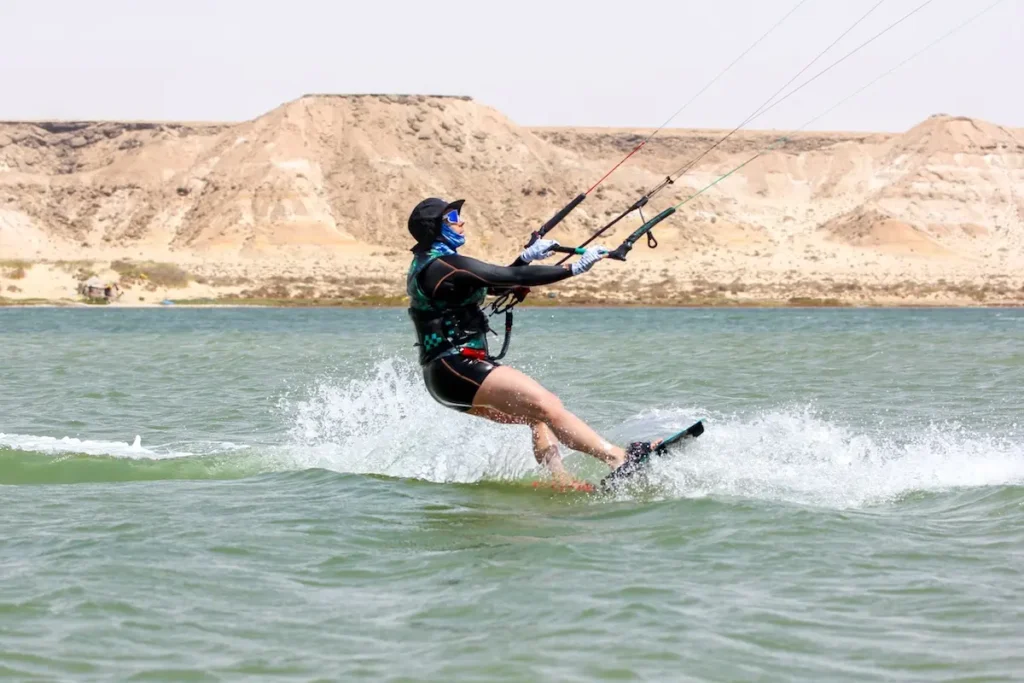
Size is the first — and most overlooked — reason a harness feels wrong. A kiteboarding harness that’s the wrong size can’t be fixed by cranking the straps tighter; it will just move the problem somewhere else.
A simple rule of thumb: think about how you buy a fitted, compressed t-shirt. If you’re a Small there, go Small in your harness. Medium there, Medium in your harness. If you sit between Medium and Large, size down to Medium rather than up. If you generally prefer looser fits in clothing, consider sizing down one size from your usual for your harness — a kiteboarding harness needs to sit snug against your body to do its job.
Harnesses come with adjustable straps and velcro closures, so there’s always a range of fine-tuning available once you’ve picked the right base size. That said, tight and over-tightened are not the same thing. A good harness should feel secure without moving, but you should still be able to breathe comfortably. We’ve seen riders cinch their waist so hard trying to “fix” a fit issue that they’ve ended up injured. Common sense first, always.
Practical tips for getting size right:
- Use the brand’s size guide. Every major harness brand (Mystic, ION, Ride Engine, Manera, Dakine, Prolimit) publishes a size chart on its website. Measure your waist at home before you buy — don’t guess.
- Sizes typically range from XS to XL/XXL across most women’s lines, so there’s more room to find your fit than there was a few years ago.
- If you’re between sizes on a hardshell harness in particular, size down where possible. Hardshells rely on a snug fit against a rigid backplate to distribute pressure correctly — too loose and that support disappears.
- Some brands now offer “tall” versions” of their hardshell harnesses for riders with a longer torso, so the backplate sits correctly along your spine instead of digging in under the ribs or riding too low. If you’ve struggled with hardshells before, ask if your size runs in a tall option before writing off the category altogether.
SHAPE: The Trickiest of the Three
We love our curves, and our harness should honor that.
Every rider has a different body shape — which means the harness that works perfectly for your kite buddy might not work at all for you. This is why shape is the hardest of the Triple S to nail down. Unlike men, who tend toward a straighter torso, women’s bodies bring a huge amount of natural variation: short backs, long torsos, narrow waists, wider hips, a fuller bust — the combinations are endless.
That variation is exactly why designing a true women’s kiteboarding harness is such a challenge for brands. They’re trying to build a handful of shapes that need to work for an enormous range of body types — kiteboarding hasn’t (yet) reached the level of the jeans industry, where you can choose from dozens of fits designed around different body shapes.
The good news is the gap is closing fast: recent women’s-specific harnesses — are built from the ground up around female measurements rather than simply scaled-down men’s molds, with closer attention to hip curvature, shorter torso panels, and bust clearance.
What to look for when assessing shape:
- Molded interior foam: Look for a kitesurf harness with foam that’s pre-shaped (not flat) to follow your lower back and hip curve. This is often called Fix Foam or similar, depending on the brand, and it’s what allows the harness to hug your body instead of sitting rigidly against it.
- Panel construction around the ribs and bust: Better women’s harnesses are cut and angled to avoid pressure across the chest, especially on seat and hybrid styles.
- Backplate height and curve, particularly on hardshell models — this is where the “tall” sizing mentioned above becomes relevant.
Unfortunately, the most reliable way to know if a harness will suit your shape — especially with waist kitesurf harnesses — is to try it on. Put it on, walk around in it, and if you can, actually kite in it before committing. A kiteboarding harness that looks great on a model or on your friend can behave completely differently on your own body.
SUPPORT: What the Harness Is Actually For
We flagged this in Part 1 and it’s worth repeating: support is the entire point of a harness. It’s what connects you to the kite, absorbs the pull, and protects your back and core through hours on the water.
Both waist and seat kiteboarding harnesses provide support — the real differences show up in how that support is delivered, how comfortable it feels over a long session, and whether it matches your riding style and body’s needs.
This is where the conversation about softshell vs. hardshell waist harnesses becomes essential — and it’s a big enough topic that we’re dedicating all of Part 3 to it. For now, here’s the short version: the difference comes down to the stiffness of the backplate.
- A softshell kitesurf harness flexes with your body, offering more freedom of movement and a more forgiving fit — a good match for freestyle, wave riding, and riders who are still finding their ideal size.
- A hardshell kitesurf harness uses a rigid (often composite or carbon) backplate that spreads the kite’s pull evenly across your back instead of letting it concentrate in one spot. This tends to reduce fatigue and lower back strain on longer or more powered sessions, but it depends much more heavily on correct sizing — a hardshell that’s slightly off will dig in rather than support you.
Hardshell technology has genuinely moved the needle for riders — women included — who struggled with lower back pain or ride-up on traditional soft waist harnesses. We’ll go deep on this in Part 3, including how to know which one is right for your body and riding style.
Some Last Tips: Is It the Harness, or Is It You?
Sometimes we blame our gear for a lack of progress or comfort — but it’s worth checking your technique and conditions first before assuming the harness is at fault.
- Harness riding up frequently? Have you tried tightening it properly, rather than just cinching the waist strap?
- Struggling to lean back and hold your edge upwind? Try bringing your kite lower in the wind window — around the 10 and 2 o’clock positions — rather than flying it high.
Of course, your gear — harness, kite, bar, board — has a real impact on your riding. But sometimes the limiting factor isn’t the equipment at all; it’s technique. Ruling that out first can save you from buying (and returning) harness after harness in search of a fix that was never about the harness to begin with.
Choose Wisely
Choosing the right kiteboarding harness is a big decision, and not just for beginners. With so many options on the market, prioritize quality and proven technology over the lowest price tag.
The range of women’s kiteboarding harnesses keeps expanding, and it can genuinely be difficult to know which model and brand will best match your riding style, body, and budget. At Kite Sisters, we’ve chosen Mystic for our own gear and couldn’t be happier with the fit and support across our team.
Kiteboarding is already an investment — don’t let the harness be the place you cut corners. Your body, your sessions, and your safety are all riding on this one piece of gear.
Next in the Series
In Part 3, we’ll go deep on hardshell vs. softshell women’s kitesurf harnesses — the technology, the trade-offs, and how to know which one fits your body and your riding style, plus a look at where harness design is heading next.
Stay comfortable. Stay safe. Keep kiting.
Recommended Kitesurf blogs:
Author: Chelu Guardati. Kite Sisters Co-Founder and IKO Kitesurf Instructor since 2010. IKO License: 12558

2 Comments

Elizabeth August 5, 2026
“Harness riding up frequently? Have you tried tightening it properly, rather than just cinching the waist strap?”
I have yet to find a harness that doesn’t ride up. What does “properly” mean in this context?

Kite Sisters August 28, 2026
Hi Elizabeth!
A few key points to properly tighten your harness:
Position it low before you tighten. A lot of people put the harness on where it feels natural (near the natural waist) and then tighten from there. The harness should actually sit lower, on your hips, with the hook at or just below your belly button — not above it. If it starts too high, no amount of tightening fixes that.
Tighten in the right order. Do the main waist strap first to lock the position, then adjust the side straps, then come back and fine-tune the waist strap again. Tightening the side straps before the waist strap is set is a common reason people end up loose in the wrong place.
Re-check the fit after your first few runs. It’s normal for straps to settle and loosen slightly once the harness has taken some real load from the kite — the webbing and padding “break in” a bit during that first stretch of riding. After a short warm-up session, come back to the beach or take a break on the water and re-tighten. Don’t assume your pre-session adjustment will hold for the whole day.