January 3, 2026
Everything you need to know before your first wingfoil lesson.
If you’ve been seeing women gliding quietly above the water, holding a soft inflatable wing and smiling like they’ve just discovered a secret… you’re not alone in wondering:
“What is wingfoiling?”
“Is wingfoiling hard to learn?”
“Could I really do this?”
The short answer is: yes — you absolutely can.
Wingfoiling is one of the most accessible and confidence-building water sports for women, especially for beginners who want a sport that feels empowering, safe, and joyful rather than intimidating.
This guide brings together everything you are searching about wingfoiling — in one place — so you can feel informed, reassured, and inspired to take your first step.
What Is Wingfoiling?
Wingfoiling (also called wing surfing or winging) is a wind-powered water sport where you stand on a board, while holding a lightweight inflatable wing in your hands and use the wind to glide across the water.
Most boards are equipped with a hydrofoil, a wing-shaped structure that sits under the board (imagiine an underwater airplane wing), below the water surface, and it’s what allows a wingfoil board to lift and “fly” above the water, once you get speed.
This creates the smooth, light and almost floating sensation that makes wingfoiling feel so special.
Unlike kitesurfing, there are no long lines, no harness and no kite flying overhead.
Many women describe wingfoiling as:
“Peaceful, intuitive, and surprisingly empowering.”
Why Wingfoiling Is So Popular With Women
Wingfoiling has grown incredibly fast — and women are a big part of that growth.
Women choose to learn wingfoiling because:
- It’s beginner-friendly: you can start wingfoiling without any previous board sports experience.
- It’s low-impact: wingfoiling is kind to the knees, hips and lower back.
- It builds confidence quickly: most women feel progress within the first couple of days, which makes the learning process motivating and fun.
- It feels safe and controllable from day one: because the wing is handheld and can be released instantly, many women feel comfortable from the very first lesson.
For many women, wingfoiling is not about pushing limits — it’s about rediscovering joy and movement in the ocean.
Is Wingfoiling Hard to Learn?
This is one of the most common questions women ask — and the honest answer is: Wingfoiling is one of the easiest wind sports to start.
Of course, every student has their own times and progression, but most beginners experience the following progression during their wingfoil lessons:
Day 1. Introduction to wingfoil, safety and first glides.
Wing handling on land and water basics.
Day 2. Standing up and board control
Stand up on the board and glide short distances.
Days 3–4. Direction & flow.
Longer glides, better balance, more control.
Days 5-6. First foil moments (if you are ready).
First controlled moments on the foil, longer rides, less falls.
Days 7 onwards. Confidence, control and progression.
Better equipment understanding, more consistent foil lift, smoother distances, first transitions.
You don’t need strength, speed, or fearlessness.
You need curiosity, patience, and good instruction.
This is why learning through proper wingfoil lessons or a structured wingfoil camp makes such a difference.
If you would like to go into a detailed lesson plan, check our blog: Wingfoil Course: What Does a Typical Beginner Wingfoil Lesson Look Like?
Wingfoiling Equipment: A Beginner Overview
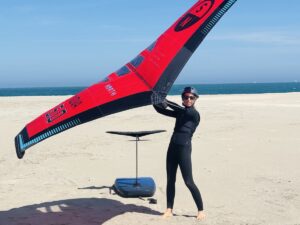
You don’t need to own gear before learning. Quality wingfoil camps and retreats provide all equipment, selected specifically for beginners.
Keep in mind that beginner gear is very different from intermediate or advanced gear. Buying too early often leads to equipment that’s too small, which translate on slower progression and unnecessary frustration.
Here’s what you’ll use — and why it matters.
The Wing
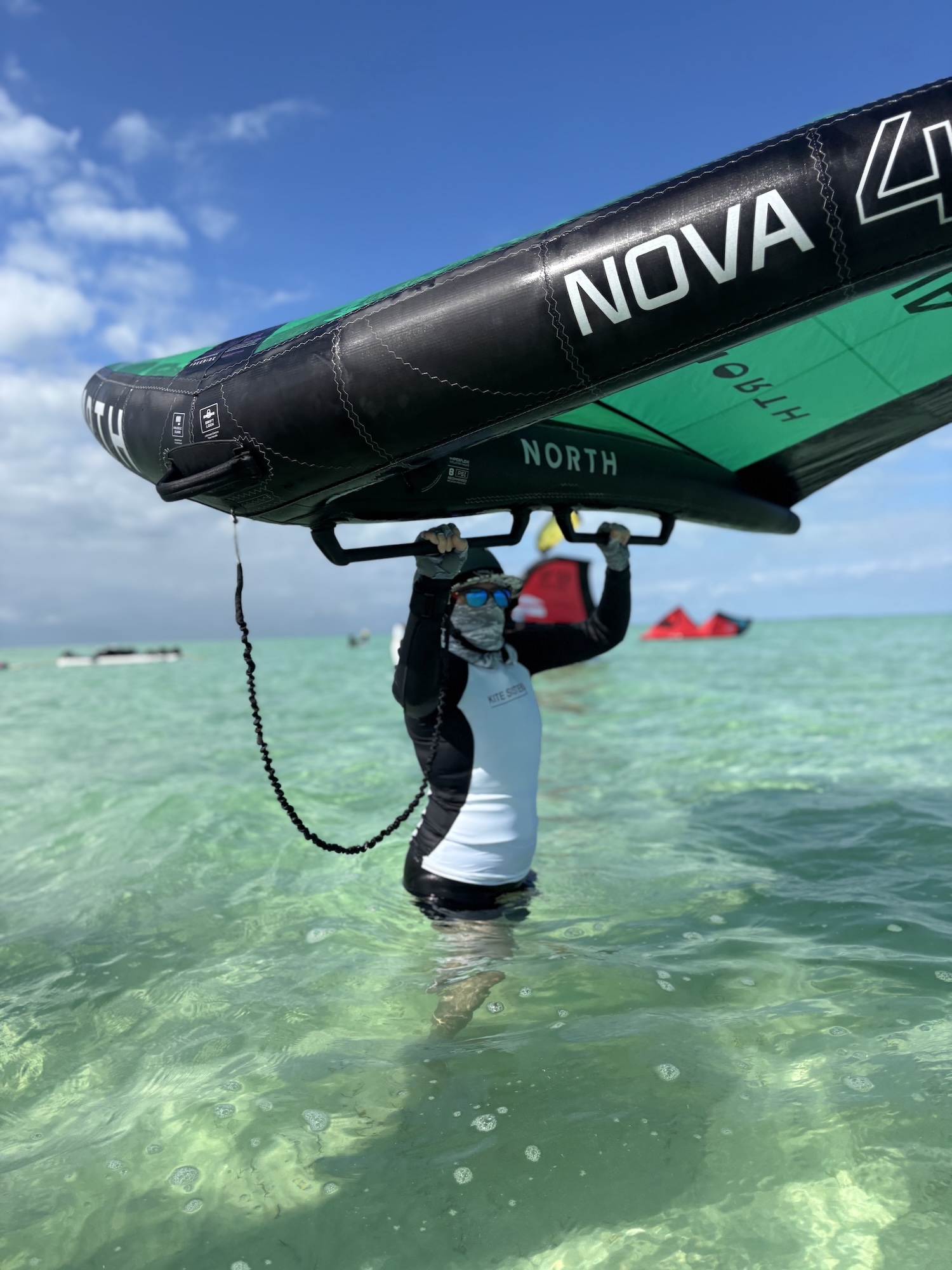
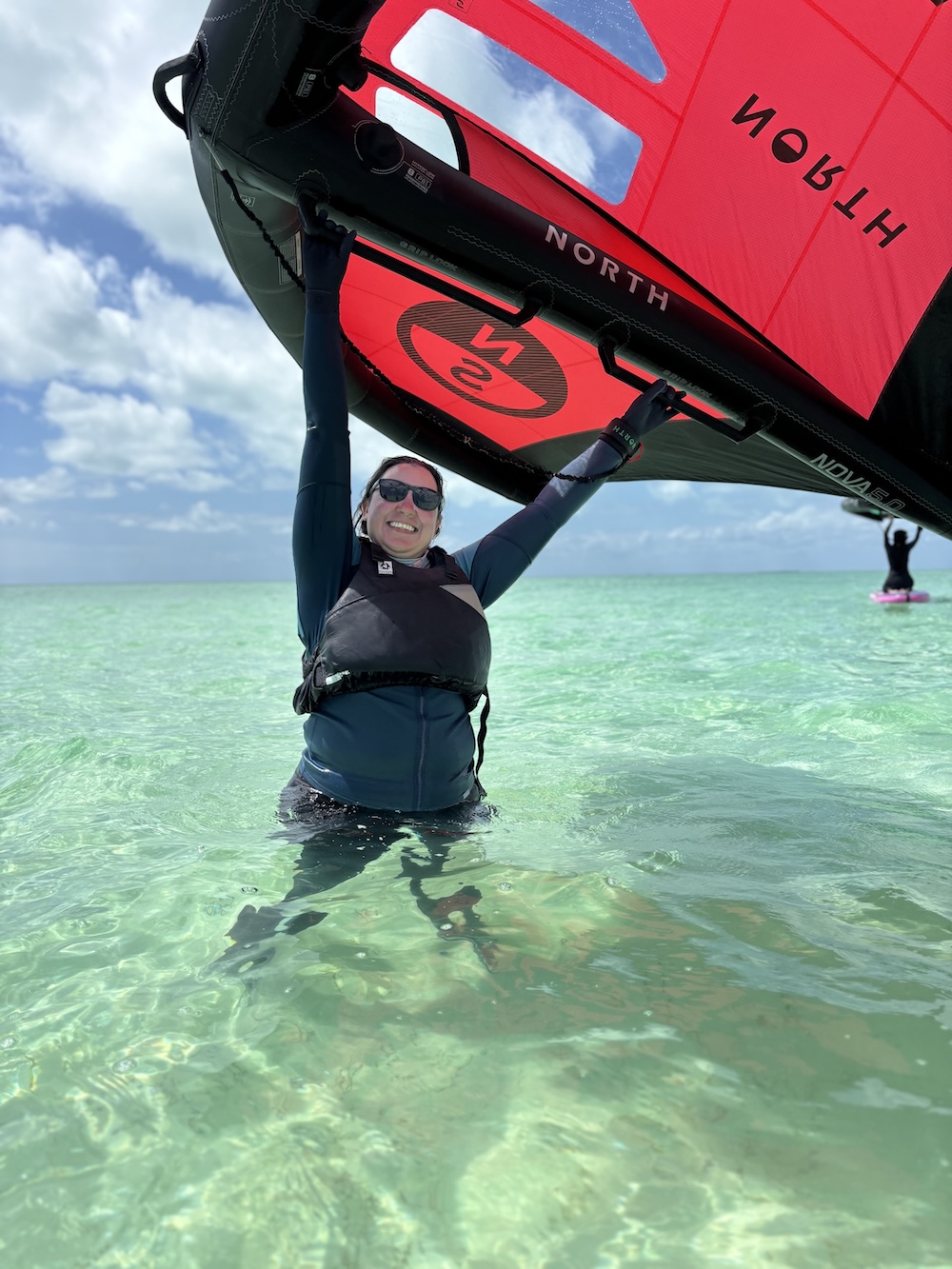
A lightweight inflatable wing that you hold with your hands. Beginner wings are stable, easy to control, and not overpowering.
Wing size is based on body weight and wind strength (such as kitesurfing).
- Bigger wings = more power in lighter wind
- Smaller wings = easier handling in stronger wind
For most beginner women, wings between 4–6 m² are commonly used during lessons.
The Board
Beginner boards are larger, thick and very stable, generally inflatable for the first lessons. They help you to kneel comfortably, stand up slowly and easily and build confidence.
Why volume matters:
Board volume (measured in liters) determines how stable the board feels.
For beginners:
- more volume = easier balance
- easier standing up
- less falling, more learning
Women often start on boards ranging from 110L–180 liters, depending on weight and conditions.
👉 Starting big is not a weakness — it’s a shortcut to confidence.
The Foil
The foil sits under the board and lifts it above the water once you gain speed. As a beginner you start with large, forgiving foils and lift happens gradually (not suddenly).
During the first lessons, you won’t foil right away. The main focus is on building technique with the wing, practicing standing up through repetition, and working on board balance.
Foiling comes naturally later, when your body and mind are ready.
A foil is made of four main parts, and each one plays a role in how stable, smooth, and forgiving your ride feels.
1. Front Wing (Main Wing): the front wing is the most important part of the foil — and the one that determines how easy wingfoiling feels as a beginner. It creates lift, determines how fast the board rises, controls stability and glide
Beginner-friendly front wings are:
larger in surface area (lifts earlier at low speed)
slower and more predictable
very stable
2. Mast: The mast is the vertical piece that connects the board to the foil. The mast sets how high you ride above the water, influencing in the stability and control.
Shorter masts (around 60–75 cm) are often used for learning
3. Stabilizer (Back Wing): the stabilizer, also called the back wing, sits behind the front wing. It keeps the foil balanced, controls pitch (nose up or down) and adds adds stability.
4. Fuselage: is the horizontal piece that connects the front wing and the stabilizer.
The safety gear
A leash connecting the wing to your hip or wrist, a second leash that connects you to the board, an impact vest, and a helmet. All of these are essential during your wingfoil course.
Is Wingfoiling Safe for a Beginner Women?
Yes — especially when learned properly with qualified instructors and in the right conditions.
Wingfoiling is considered very safe because:
- the wing can be dropped instantly
- there are no lines or high-speed pulls
- falls are soft
- boards are stable and buoyant.
Even if it’s not necessary to be fit or athletic to learn wingfoiling, keep in mind that learning to wingfoil can be exhausting at times, and you will fall off your board a lot—especially if you don’t have any previous experience in water or wind sports.
Give yourself time to rest between runs and recover!
Why Learning With Certified IWO/IKO Instructors Matters
Not all instruction is equal — and this is where real professionalism shows.
IKO is the International Kiteboarding Organization and IWO is the International Wingfoil Organization.
Being wingfoiling a brand new water sport, the IWO is still a young organization, but it has been founded by professional wingfoil instructors with more than 20 years of experience in watersports education and coming from the world leader IKO, which has been a central authority in kiteboarding education and safety for more than two decades.
At Kite Sisters, we work with IKO & IWO instructors that follow a proven teaching system:
- land-based wing control
- controlled board skills
- progressive foil introduction
No guessing. No rushing.
Why Learn Wingfoiling at a Women’s wingfoil Camp or Retreat?
A wingfoil retreat combines everything you need:
- professional wingfoil lessons
- beginner-optimized equipment
- ideal learning conditions
- consistent daily practice
- encouragement from other women
Many women say:
“I learned more in one week at a camp than I ever could alone.”
Wingfoiling Is for You
You are not too old.
You are not too late.
You are not “not sporty enough.”
Wingfoiling meets you exactly where you are — and gently invites you forward.
With qualified instruction, the right environment, and supportive guidance, wingfoiling becomes not just a sport… but a deeply rewarding experience.
Ready to Learn Wingfoiling?
Our women-only wingfoil camps and retreats are led by experienced certified instructors, using beginner-friendly equipment and a teaching approach designed specifically for women.
You don’t need to figure it out alone.
We’ll guide you — step by step — onto the water.
Check the next Kite Sisters Wingfoil Retreats and Camps HERE and learn wingfoiling with us on a safe, empowering and curated experience.
Author: Chelu Guardati. Kite Sisters Co-Founder and IKO Kitesurf Instructor since 2010. IKO License: 12558